
Almost without exception my posts are an argument: an attempt to persuade; or a provocation; or a perspective designed to prompt reflection.
Often making my argument, to whichever intended effect, involves posing questions. However, in some senses these tend not to be genuine questions. Mostly, if not actually rhetorical, these questions are framing devices, the answers to which I already have in mind as these support me in making the argument I want to make in the post.
This post is slightly different as it asks a question that, for want of a better word, I’d describe as genuine. I don’t, and would like to, know the answer(s).
And it’s about degree apprenticeships.
where we want to be
Over the last few weeks higher education has been in the political spotlight in a manner that in many ways it would not wish. At the end of last month the Department for Education (DfE) announced its intention ‘to end degree by default culture and boost youth apprenticeships’. This press release focused much more on its critique of the former than its plans for the latter, but to the extent that it talked about apprenticeships the focus appeared to be more on lower level than degree apprenticeships.
However, one of the (multitude of)former ministers responsible for higher education under the previous government was quick to enter the lists on degree apprenticeships, with Robert Halfon arguing on the back of DfE announcement:
we have to break the false choice between academic and technical routes and give apprenticeships genuine parity of esteem … Degree apprenticeships and apprenticeships per se are the clearest answer to that false binary: a full degree, real work, no debt, and a job at the end — the ladder of opportunity made real, especially for young people from disadvantaged backgrounds.
This is an argument that Halfon consistently made while he was an MP, and in his two spells as Minister for Skills, Apprenticeships and Higher Education. And in many ways it has much to recommend it.
where we are
Degree apprenticeships undoubtedly offer huge opportunities, and their development is a positive higher education legacy (one of the few) of the post-2010 Conservative governments. Following their introduction in 2017 there was notable growth in degree apprenticeships:
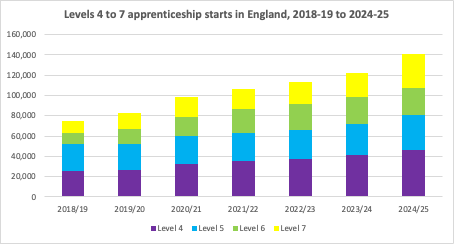
Source: House of Commons Library, Apprenticeship Statistics for England (2025)
Impressive. But also far short of Halfon’s stated aspiration in 2017 (when admittedly he Halfon was Chair of a Select Committee rather than a Minister) for half of all higher education students to be undertaking degree apprenticeships.
Which begs the obvious question: why have the more ambitious hopes (even if not to the heights advocated by Halfon) for expansion not been met?
why are we here?
Often the blame is laid at the door of universities.
Too rigid and inflexible in their systems and processes. Unable to innovate. Self-interestedly staying in their comfort zone of the traditional degree. Determined to protect and promote obscure, ivory tower higher education rather than meet the practical, skills needs of the nation.
These aren’t the issues I’m interested in this post.
They are all supply-side issues; the fault for the lack of sufficient growth in degree apprenticeships rests with universities, as the providers of higher education. But is the most salient factor actually a demand-side issue?
In order for a university to recruit a degree apprentice, there first needs to be an apprentice. An employer needs to create that paid job for an apprentice, taking on the salary and on-costs of that role. Consequently the number of degree apprentices supply of degree apprentice depends on this demand; and which is entirely dictated by the hiring activity of companies and organisations (in a country where employers are ever less willing to invest in workforce development).
what’s really stopping us?
And if that’s the case, isn’t increasing the proportion of higher education students undertaking degree apprenticeships much more dependent on behaviours and actions in the wider economy, than it is on those in universities?
That’s my question.








Leave a Reply