
As the autumn brings in the start of the (traditional) academic year, it’s difficult to look back on what has (even in the context of the storms that have been raging in the sector for the last two to three years.) in many ways been a challenging summer for UK higher education.
The response to Andy Burnham’s education speech in July, where he declared that ‘Britain will value the hard hat every bit as much of the graduation cap’ is perhaps far from being the most serious of these developments. It was still, though, interesting if slightly odd.
the same old song
This speech was, of course, a further occasion for much of traditional and new media to seek to inflame hostilities on the higher education front of the culture wars. It even led to yet another round of headlines about the end of the Blair 50% target for higher education participation (the frequency of the demise of which makes the single posthumous execution of Oliver Cromwell in 1661 look like timid moderation).
And, of course, fire was returned across this frontline.
It was pointed out (not unreasonably, as Burnham had said this himself) that seeking equal esteem between the technical and academic routes should not be seen as a criticism of the value of the latter. Commentators also, predictably but fairly, highlighted the multiple shortcomings of such a binary divide: the immense scale of provision in universities that is technical and vocational in nature; the extent of the economic demand for higher level skills the UK will need to meet in the coming years; and, even more fundamentally, the way in which the technical and academic are so often fundamentally intertwined at all levels of education.
So why was all of this odd? While the performative nature of much of the commentary was frustrating, wasn’t it all predictable? That’s the way life is. Isn’t it?
brighter times?
One reason for the oddness stemmed from the announcement itself. While the line to take from the government deliberately put universities in the line of fire, the announcement itself said little if anything of substance about higher education. It was essentially a speech about 14 to 19 education, with the focus such as it was on greater scope for technical education from 14 onwards.
Such as it was?
That’s a reference to a second cause of the sense of oddness about the speech: what isn’t a surprise now, but perhaps standing back should be; the lack of substance, even in the 14 to 19 space, in what our new Prime Minister said.
It’s fair to say that Burnham paints in primary colours, with little of the light or shade that’s provided by policy and implementation detail. In some senses it’s tempting to welcome this. In terms of recent public discourse, Burnham’s three colours is one better than the black and white in which so much debate now takes place. And the primary colours themselves are a damn sight more cheery than the monochrome that has dominated political discussion for far too long. Nevertheless, the lack of substance beneath the vibes may well pall before this autumn is out.
the tertiary turn
The final oddness relates more particularly, for me at least, to higher education and universities.
As noted above, part of the defence in response to (yet another) attack on universities was to seek to counter the characterisation of universities as the preserve of an elitist, detached form of academic education of insufficient relevance to the current needs of students, employers and society.
In addition to the aspects of this picked out earlier, some have pointed to the diversity of higher education providers including the extent to which higher education of quality and relevance is now frequently delivered by, and in partnership with, the further education sector. A fair, valid and relevant point. And very much in keeping with the current emphasis across the UK on the need to think and act in terms of an integrated tertiary sector, rather than the old silos of higher and further education.
All of which I largely agree with, so why do I think there’s an element of oddness here?
the tension
The tertiary turn in education policy is essential, but it’s tempting to think that it downplays a crucial tension: funding.
There are multiple dimensions to this, but one is that both the higher education and further education providers are facing hugely challenging financial headwinds. The funding levels for both sectors aren’t sustainable, and both sectors are looking to government in one way or other for additional financial support. And of course, no UK government can afford this.
As Stephen Bush repeatedly points in the Financial Times, the post important chart in UK politics is this one:
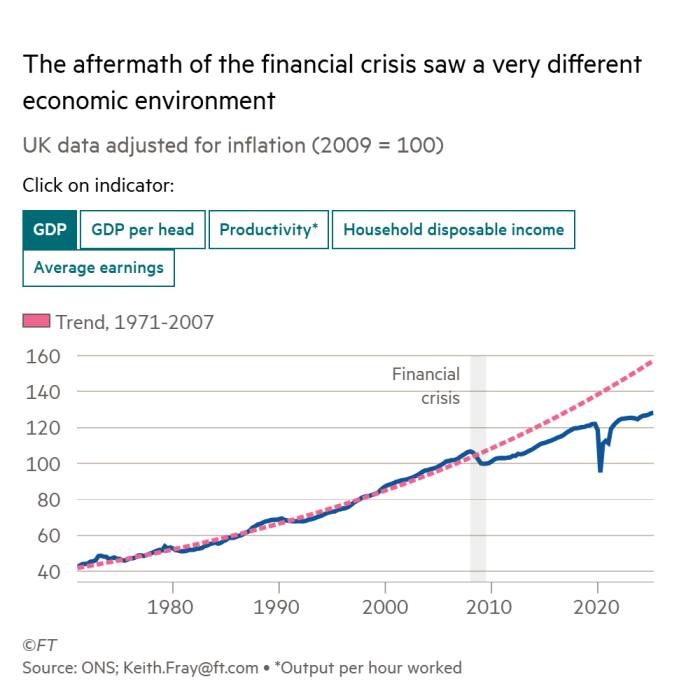
The UK is now significantly poorer than it has been, or would expect to be. It is this that explains why the country is now struggling to afford what it once did. This dictates the art of the possible for education funding. And what’s possible over and above what we have now, isn’t very much.
It’s in that context that the interests of the higher and further education sectors diverge.
Further education suffered savage cuts in the 2010s, which were deeply damaging to the sector; those who work in it; and most crucially its students. To be frank, if any additional public funding is available, further education’s need is greater than higher’s. From a practical perspective, further education is the funding priority.
A second reason is linked to this.
Higher education’s lesser call on the public purse is not just a consequence of the relative (compared to further education) comfort of the 2010s, based on the 2012 financial settlement with the move to £9,000 home undergraduate fees. It is also based on what this settlement represented: the replacement of public sector with student fees. A private good created from a public good.
This was higher education’s water privatisation. Just as harmful. Just as fundamental. And just as difficult and expensive, and consequently unlikely, to be reversed. And having chosen this road, higher education’s moral case for additional public funding is crucially undermined and has been for over a decade now.
where we are
So despite the necessity of the current tertiary turn in the UK, in England at least it elides the continuing and natural tension between higher and further educations with the same desire to call on additional public funding; but in the knowledge of the tension between the demands of the two. And the position in which higher education has to engage with and manage this tension, doesn’t sit well with many in the higher education sector, including me. But thanks to the decisions made by government and sector leaders in England in the early 2010s, whether we like it or not, for higher education that’s the way life is.






Leave a Reply