
Image generated with Google Gemini
I suspect that every sector of the economy and society regards itself as different and special, in just the same way as does every academic department/discipline in a university. And that in both cases this is both true and untrue, depending on the perspective taken.
Thinking of the current travails of UK higher education this is absolutely the case, in the context of those faced by the rest of the economy and society. Yes universities are facing hugely challenging times, for real, distinctive and serious reasons; but of what sector of the UK’s economy and society is that not true?
the stormy present
But of course confronted by the financial storms faced by students, graduates and universities, and what can seem like the ever growing critique of universities (leading the sector to start to question whether it has lost its social licence), there is a risk that it can all seem very bleak in higher education.
In the face of this, the danger of descent into bleak miserabilism is all too real; particularly when alternative perspectives all too easily slip into Panglossian bromides or fiscal fantasies. A descent even more likely, perhaps, for those of us whose character generally tends to lean more towards the pessimistic (there’s a reason why a Dean once referred to me as Eeyore; I like to think with at least a little affection, but …).
Sometimes, though, something comes along that, at least briefly and to a small extent, breaks the spell of miserablism. A small chink of light in the dark skies, that may perhaps disappear again shortly but still brightens things if only for a while.
Such a moment came on me last Friday. And to my surprise, it was thanks to the Office for Students. Or more accurately it was from students, mediated by OfS, as the break in the clouds was the publication of the latest report of its regular Student Pulse Survey.
how to measure a storm
Not the highest profile of OfS’s activities, the Student Pulse Survey (SPS) was launched in autumn 2024 and it’s in effect an opinion poll of students. A short survey ‘that tracks student views on issues of sustained importance to the Office for Students (OfS), as a regulator’. It’s taken by a representative sample of c.1,200 students, and has now been run on eight occasions since its inception in Autumn 2024.
It’s a small and imperfect way of gathering information on student views, and perhaps one (no doubt flawed) way of seeing it is as to the NSS, what an opinion poll of voting intention is to real election. And as with opinion polls of voting intention there are, for good reasons, strong health warnings on placing too much weight on the SPS. However, while it is only part of a broader approach (e.g. NSS, Student Panel) it remains a valid approach, and as with political opinion polls it can provide interesting insights.
The timing of the establishment of the SPS is important. It started just as the everything grew particularly dark and bleak for higher education; the breakdown of the sector’s underpinning business model was starting to bite hard, leading to a wave of restructuring and job losses along with other cuts to non-staff budgets. Alongside which, the cost of living crisis has continued to hit students as this has combined with the continual erosion of student financial support by government.
All of which led me to open the PDF of the latest SPS with a slight sense of dread as to what it would show, given the reports of reductions in staffing, cuts in learning resources, increased class sizes, reductions in optional module choice etc. that many students will have experienced through the period over which the SPS has run.
the data
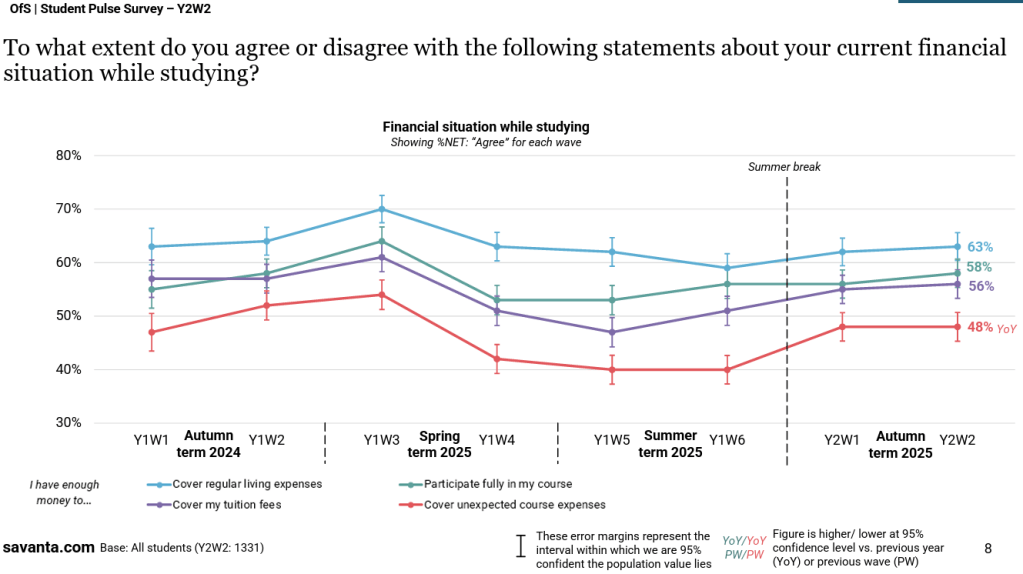
But instead of encountering a decline in scores to rival a downhill ski slope, over the last 15 months the SPS scores have remained essentially steady.
Students experiencing programmes that aren’t what they signed up for, due to cuts resulting from financial problems? Not, according to the SPS, to any greater extent this year than last:
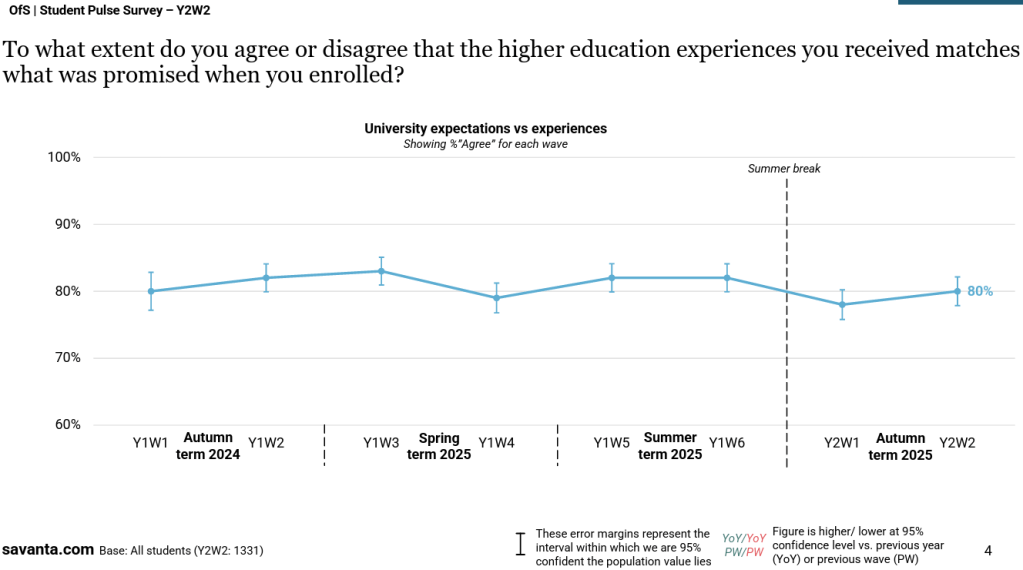
Reduced staffing numbers impacting on the support that students receive? Again, SPS results would indicate that there’s no deterioration; perhaps even an improvement.
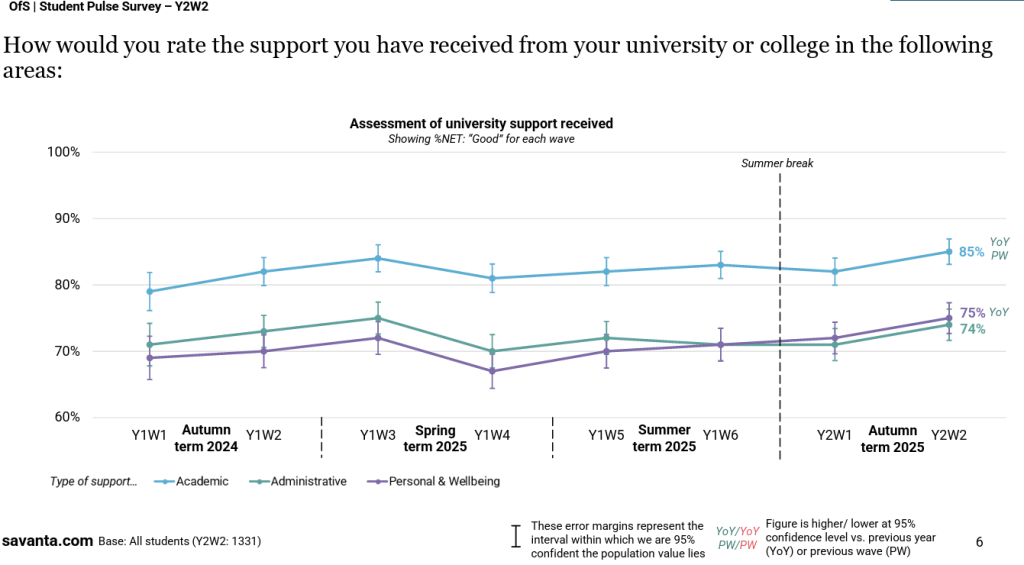
Things look a little different in respect of students views on their own financial situation. And while the increase in scores this autumn compared to last summer may reflect nothing more than the cyclical nature of of many students’ finances, the scores are not on as significant a downward trend as might have been expected.
the dogs that haven’t barked (yet?)
As noted above, care needs to be taken not to place too much weight on what is still a relatively slight evidential base.
It could be argued that even where the results for the questions quoted above are flat, or increasing, that still leaves too high a percentage of students answering in the negative. That the scores for many if not all of the questions on the financial situation students are worrying. And that it will be only a matter of time before the impacts of the recent and ongoing remaking of English higher education starts to have significant, negative demonstrable impacts on student perceptions of their experience.
But for right now I’m choosing to park my miserablism even if only briefly; and choosing to see these SPS results as a small shaft of light in the currently gloomy skies, even if the current winds of change in higher education mean that the clouds shortly close this gap again.


 left to my own devices - occasional thoughts on higher education
Leave a comment