
Image from picryl.com
In every significant body of work, there are elements that are more frequently engaged with. Some of these are better known and others less part of the zeitgeist but still the subject of some fervour for many.
There is also a material element of this body that’s less engaged with. In many cases this amounts to lost gems; occasionally the relative obscurity is, perhaps, more deserved.
the canon
OfS’s regulatory architecture is undeniably a significant body of work. The Regulatory Framework weighs in at 221 pages; and it’s supported by 18 currently relevant items of Regulatory Advice, which total 569 pages.
(Soon to be added to of course by Regulatory Advice on academic freedom and freedom of speech, the draft of which was 37 pages; well, in February OfS committed to its publication in time for the new duties coming into effect on 1 Aug. 2025; we’re still waiting).
Within this 790 page canon, I suspect that for a while Regulatory Advice 19: The OfS’s approach to determining the amount of a monetary penalty was probably a deep cut; of interest largely to devoted OfS-heads (suggestions of other names for OfS ‘superfans’ very much welcome – the inspiration for my choice of ‘OfS-heads’ is entirely predictable).
a sleeper hit?
Interest in Regulatory Advice 19 is, I suspect, starting to grow following the collective dropping of jaws in the higher education sector at the £585,000 fine levied on Sussex in respect of the Kathleen Stock case (known of course to OfS-heads by it’s correct title as decisions relating to breaches of Conditions E1 and E2 and the imposition of monetary penalties).
And this interest in this element OfS’s back catalogue may have been further heightened by OfS’s recent new release, with a £115,000 price tag featuring Leeds Trinity University – settlement relating to breaches of OfS requirements relating to oversight of partnership arrangements.
All of which led me to wonder, and to dig a little into, what’s happened to date in terms of the ‘regulatory interventions’ set out in OfS’s Regulatory Case Reports.
the caveats
One is highlighted by OfS on the webpage hosting these reports: ‘please note that we do not publish regulatory case reports for all our regulatory activity’. And a further caveat as that in some cases OfS has issued Regulatory Case Reports for changes of provider name (Newman University; New College of the Humanities), while in one the concern was not upheld (Stratford College London), and I’m excluding these from what follows.
Perhaps most importantly I’m only interested in this post in the Case Reports that led to a monetary penalty. There are multiple Case Reports relating to matters of academic quality and standards, which led to one or more of an additional specific condition of registration, an institutional action plan and enhanced monitoring by OfS. Similar ‘must do better’ requirements resulted from the first round of investigations into providers not meeting the outcomes thresholds in Condition B3.
Rather, the focus in this post is on those occasions when OfS has told a higher education provider to …
… reach for your wallet
OfS does this under Section 15 and Schedule 3 of HERA; HERA gives OfS the power, and the scope/scale is then set by the Monetary Penalties Regulations. OfS is allowed to fine providers up to 2% of their ‘qualifying income’ – essentially the total income from fees and OfS grants in the year in which the offence has been committed.
And it’s in this context that OfS sets out in Regulatory Advice 19 how it will determine a monetary penalty when it is decided such a penalty is needed:
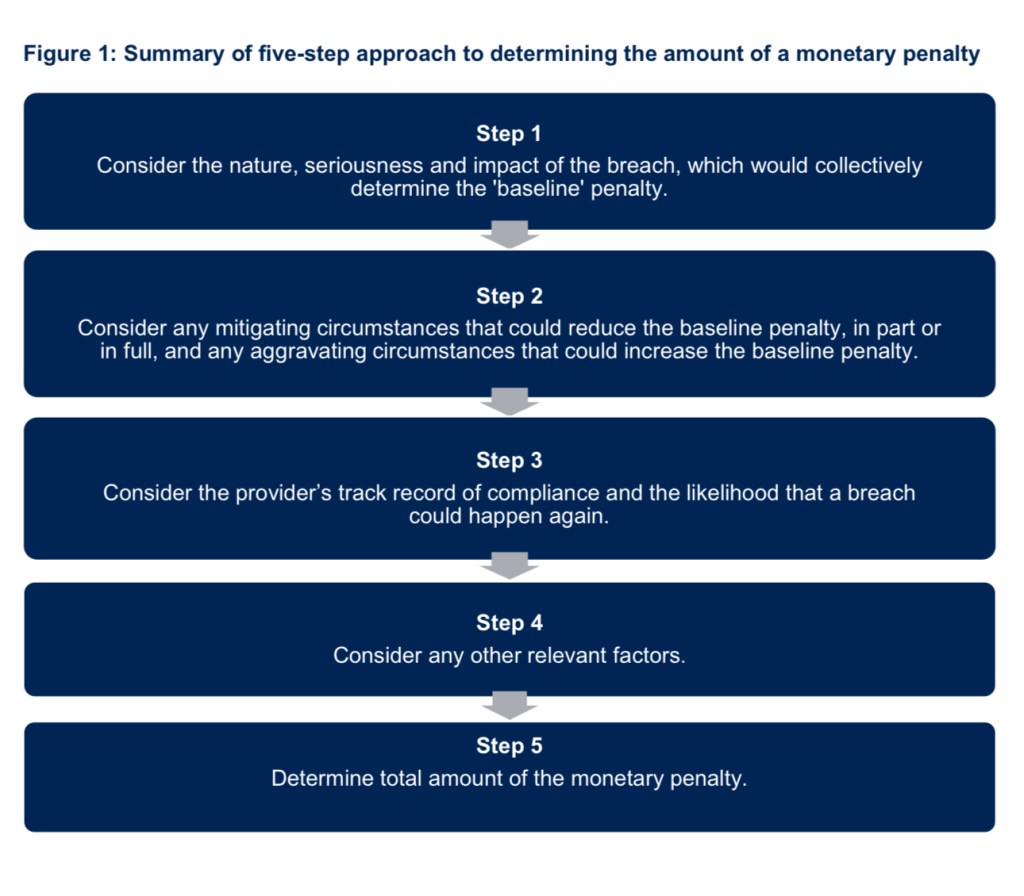
All very logical and rational, though it does miss out what is in effect Step 0 – determining the qualifying amount (i.e. the maximum fine, 2% of the qualifying income).
So how does this work out in practice in the four cases where financial penalties have been levied?
| Buckingham | Raindance Educational Services | Leeds Trinity | Sussex | |
| Step 0 | £744,614 | Not stated | £1,269,000 | £4,647,177 |
| Step 1 | £167,538 | £20,000 | £190,350 | £3,253,024 |
| Step 2 | £74,461 | £22,000 | £3,771,742 | |
| Step 3 | £55,846 | £22,000 | £3,717,742 | |
| Step 4 | £37,321 | £16,000 | £585,000 | |
| Step 5 | £37,321 | £1,000 | £164,285 (£115,000) | £585,000 |
This is a very small and therefore limited dataset. It’s also incomplete given that OfS don’t state the qualifying amount for Raindance, and then don’t detail how they arrived at the Leeds Trinity figures – the latter no doubt due to the fact that Leeds Trinity settled with OfS, leading to the discounted fine of £115K which otherwise (if my maths is right) would have been £164K.
There are, though, still some things that draw the eye.
always watch the magician’s hands
The standout is the huge reductions in three cases between the initial baseline penalty and the final penalty levied. In Buckingham’s case the final penalty is 22% of the baseline penalty; for Raindance it’s 5%; and for Sussex it’s 18%. Leeds Trinity is the outlier, at 86% (or 60% if the discount awarded for the ‘guilty plea’ is taken into account).
I’m not complaining about that in one sense; who wants to take money away from students’ education and give it to OfS?. And as the figure above shows OfS takes a range of factors into account as it moves through the five stages.
What’s interesting though is where the significant falls occur in two of these cases. All of the steps involve an element of judgment by OfS, but Steps 1 to 3 are a bit more mechanical in nature and they come across as such in the Regulatory Case Reports. Steps 4 and 5 are much vaguer in nature: OfS will look at ‘relevant factors’.
And for Raindance and Sussex this is where the big reductions took place. For the former, at the end of Stage 3 the fine was 110% of the baseline fine; at the end of Stage 5 it was 5%. In Sussex’s case the fine at the end of Stage 3 was 116% percent of the baseline, only to fall to 18% at Stage 4 and stay there at Stage 5.
so what?
Of course Regulatory Advice 19 gives an indication of what might come into play in Steps 4 and 5, and the Regulatory Case Reports in question set out a rationale for the reductions doled out at these steps, in those case (though of course words can be used to obscure or illuminate). However, the room that Regulatory Advice 19 leaves for OfS’s judgment at these steps is capacious.
For providers going through this it perhaps looks and feels that by Steps 4 and 5 penalty-setting is less a process, and more a game of chance. Certainly reading the penalty-setting elements of these reports, the sense of tension and jeopardy grows as you try to guess where the story will end and in (at least) two cases the reader is rewarded with surprise twist at the end.
I’m not sure what to think about this. As I say, the dataset is small. And I’m a big believer in processes leaving space for the exercise professional judgment in relation to the specific case being considered.
But where significant space is left for professional judgment, there needs to be high levels of trust between the various participants. Despite recent claims about improving relations between OfS and the sector, I’m not entirely convinced; it doesn’t feel like that on the ground in the sector, when providers are talking without OfS in the (physical or virtual) room.
So I’m left with a certain sense of unease about how this may be playing out currently in respect of monetary penalties. As I say, it’s early days with few monetary penalties levied. Perhaps this will settle down: preferably due to fewer actions by providers requiring monetary fines; if not, then as the body of case law on this expands. Either way, we need to have fewer surprises in this space.







 left to my own devices - occasional thoughts on higher education
Leave a comment